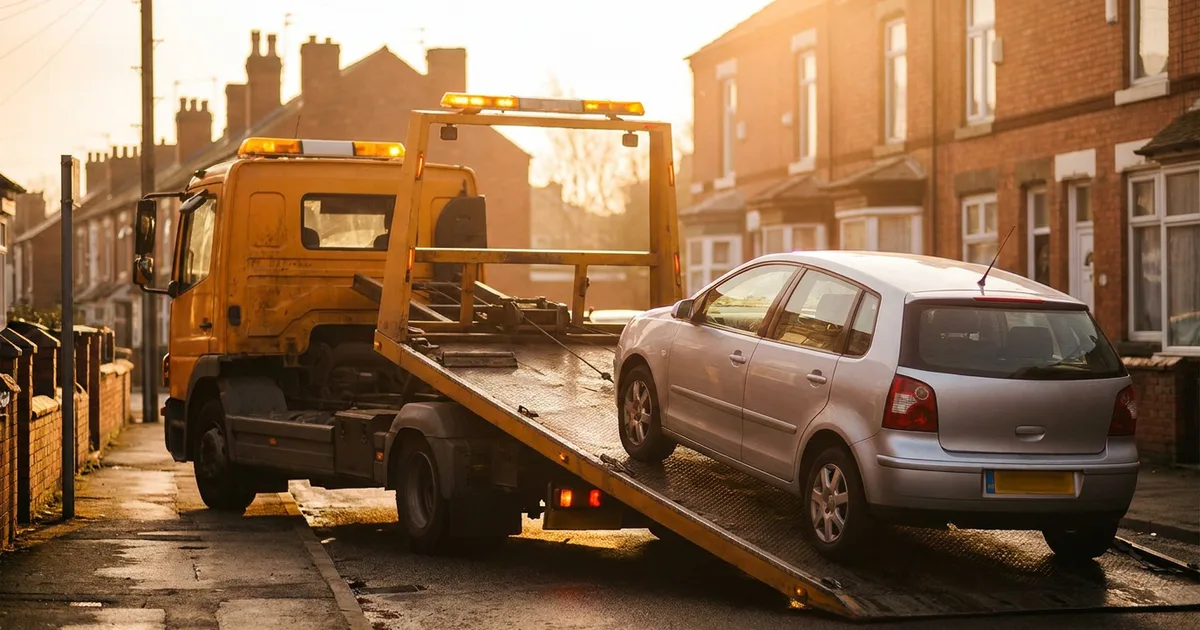
Car recovery is the service that moves a vehicle that can’t — or shouldn’t — be driven: it’s loaded onto a recovery truck and transported to a garage, your home or wherever it needs to go after a breakdown, accident or fault. In the UK you typically pay a call-out fee of £75–£95 plus £1.50–£3.00 per mile.
That’s the one-paragraph version. The longer version is worth ten minutes of your time, because the difference between knowing how recovery works and not knowing can be a couple of hundred pounds and an hour on a cold hard shoulder. This guide covers what recovery actually is, how it differs from roadside repair, how the pricing formula works, what kind of truck turns up, and what to do while you wait — with specific notes for Birmingham and West Midlands drivers at the end.
What Is Car Recovery? (And How It Differs From Roadside Assistance)
People use “recovery”, “towing” and “breakdown service” interchangeably, but the industry splits them cleanly:
- Roadside assistance tries to fix the fault where you are — a jump start, a wheel change, a fuse, enough of a patch to get you moving again.
- Car recovery transports the vehicle. The car is winched or driven onto a recovery truck (or lifted at one axle) and carried to a garage, your home, a dealer or a storage yard.
- Breakdown cover is the subscription product (AA, RAC, Green Flag) that pays for some mix of the two, up to the limits of your policy.
You need recovery whenever the car can’t be made safe and legal to drive at the roadside. That includes obvious cases — a dead gearbox, accident damage, a snapped clutch cable — and less obvious ones, like an electric car that’s run out of charge or a warning light that puts the engine into limp mode on a motorway. Recovery firms don’t judge the reason; moving un-driveable vehicles is the whole job.
Breakdown Recovery vs Accident Recovery
Both end with your car on a truck, but they’re different jobs in practice.
Breakdown recovery is the routine case: a mechanical or electrical failure, a car that starts but shouldn’t be driven, or one that won’t start at all. The vehicle is intact, it rolls and steers, and the priority is simply getting it — and you — somewhere useful. Most jobs are loaded and moving within 15 minutes of the truck arriving.
Accident recovery deals with damaged vehicles, and that changes the equipment and the process. A car with a caved-in wing, locked wheels or deployed airbags may need to be winched, dragged onto skates or lifted rather than driven aboard. There may be debris to clear, fluids on the road, and an insurer (or the police) taking an interest in where the vehicle ends up. A good accident recovery operator works quickly, documents the vehicle’s condition, and delivers it wherever you or your insurer specify.
One warning that belongs in every UK guide: if your crashed or broken-down car is blocking the road and the police arrange the recovery, you lose control of the price. Statutory removal fees apply — set by the Removal, Storage and Disposal of Vehicles (Prescribed Sums and Charges) Regulations — plus daily storage charges from the pound. If the car is disabled but not dangerously placed, you usually have a short window to call an operator yourself first. Use it.
Recovery or Roadside Repair: Which Do You Actually Need?
Plenty of stranded drivers pay for a recovery they didn’t need — and a few try to drive on when they really shouldn’t. Here’s how the common faults usually resolve:
| What’s happened | Usual answer |
|---|---|
| Flat battery | Jump start at the roadside; recovery only if the battery or alternator won’t hold charge |
| Flat tyre (usable spare or repair kit) | Roadside wheel change — no recovery needed |
| Flat tyre (no spare, damaged rim) | Recovery to a tyre fitter |
| Clutch, gearbox or driveshaft failure | Recovery — not fixable at the roadside |
| Overheating / suspected head gasket | Recovery — driving on risks writing off the engine |
| Wrong fuel (not yet started) | Recovery to a garage or a mobile fuel-drain service |
| Accident damage, however minor it looks | Recovery if anything rubs, leaks or lights up the dash |
| Electric car out of charge | Flatbed recovery to a charge point |
| Keys locked in / lost | Auto locksmith first; recovery as fallback |
The practical tip: describe the symptoms honestly when you phone. A decent operator will tell you if what you need is a £40 jump start rather than a £120 recovery — it costs them less time too.
How Car Recovery Pricing Works: Call-Out Fee + Per-Mile
Almost every independent recovery firm in the UK builds its price the same way, from three parts:
1. The call-out fee — roughly £75–£95. This is the fixed cost of getting a truck and driver to you and loading the vehicle, and you pay it however short the tow. Very cheap advertised call-outs (£50 or less) often grow once the job is assessed, so confirm what the figure includes.
2. The mileage charge — £1.50–£3.00 per mile. This covers the loaded journey to your destination. One question worth asking every time: is mileage billed from my location, or from your base? The same 10-mile tow can be invoiced as 10 miles or 25 depending on the answer.
3. Timing and situation multipliers. Evenings, weekends and bank holidays typically add £40–£90. Motorway recoveries cost more again — operators need specific accreditation to work on the strategic road network, so there’s less competition and more complexity. Vehicle type matters too: vans, 4x4s and anything that must travel on a flatbed (EVs, automatics, lowered cars) sit at the upper end of the range.
Put together, a local daytime job usually lands between £80 and £140, a 10–15 mile recovery between £110 and £200, and long-distance work is quoted per job. If you’re in the West Midlands and want the scenario-by-scenario numbers — city centre vs M6 vs Spaghetti Junction vs police pound — we’ve published a full local breakdown in our Birmingham car recovery price guide.
Get the total confirmed before the truck sets off: call-out fee + mileage + any out-of-hours surcharge, and whether VAT is included. A firm that quotes a fixed all-in price on the phone has nothing to hide.
What Turns Up: Flatbed vs Spectacle Lift
Two kinds of truck do the vast majority of UK recovery work, and it’s worth knowing which your car needs.
A spectacle lift (or “spec lift”) raises one axle and tows the car on its other two wheels. It’s fast, manoeuvrable in tight streets and multi-storey car parks, and perfectly safe for most front-wheel-drive manual cars over short distances.
A flatbed carries the whole vehicle off the ground. It’s the required option for:
- Electric vehicles — most manufacturers prohibit towing an EV with driven wheels rolling, because the motors generate current as they turn;
- Automatics and 4x4s — transmission damage risk when towed on their wheels;
- Accident-damaged, lowered and prestige vehicles — anything that can’t roll safely or sits too low for a lift.
Motorbikes are their own category again: they travel on a flatbed or trailer, secured with soft straps and wheel chocks, and not every car recovery firm carries the right kit. If you ride, check the operator handles bikes properly — ours is a dedicated service, covered on our motorbike recovery Birmingham page.
The takeaway is simple: tell the operator exactly what you drive when you call. It’s the difference between one truck arriving and the right truck arriving.
Broken Down? What to Do While You Wait
Recovery trucks are quick, but the 30–60 minutes before one arrives is when breakdowns become dangerous. The Highway Code (rules 274–287) sets out the essentials:
- On an ordinary road: get the car as far out of traffic as you can, hazard lights on, sidelights on at night or in poor visibility. Place a warning triangle at least 45 metres behind the car if it’s safe to — but never use one on a motorway.
- On a motorway with a hard shoulder: pull as far left as possible with the wheels turned left, exit through the passenger-side doors, and wait behind the barrier, uphill of the vehicle. Don’t attempt even a small repair on the hard shoulder — the AA’s motorway advice is blunt about this, and it’s right. Use the orange SOS phones or call National Highways on 0300 123 5000 to report your position, then call your recovery firm.
- On a smart motorway with no hard shoulder: aim for an emergency refuge area (the orange-surfaced lay-bys, roughly every 1.5 miles). If you’re stuck in a live lane and can’t get out safely, stay belted in with hazards on and dial 999 so the lane can be closed. The RAC’s hard shoulder guide covers the variations well.
One more habit worth forming: before you call anyone, work out where you actually are. A junction number, mile marker, postcode or what3words location shaves real minutes off every recovery.
Breakdown Cover or Pay-As-You-Go Recovery?
Annual breakdown cover runs roughly £80–£150 for a mainstream policy, and typically includes a tow of up to 10 miles — beyond that you pay per mile anyway. Pay-as-you-go recovery costs nothing until the day you need it, then £80–£350 depending on the job.
The honest arithmetic: if you drive a reasonably new car and break down once every few years, paying per use is usually cheaper than a decade of membership fees. If you rack up serious miles, run an older vehicle or spend your life on the motorway network, cover with national recovery included earns its keep. We’ve set the two options against each other, with current membership prices, in the Birmingham price guide.
Car Recovery in Birmingham and the West Midlands
Everything above applies anywhere in the UK. Birmingham adds one complication: the city sits inside a knot of motorways — the M6, M5, M42, M6 Toll and A38(M), meeting at Spaghetti Junction — so a high share of local breakdowns happen in exactly the places where recovery is most urgent and most regulated.
That’s the gap Birmingham Car Recovery exists to fill: a local, fully insured team with a 30–45 minute average response, fixed all-in prices quoted on the phone, and trucks running round the clock. Depending on where you’re stuck:
- 24 hour breakdown recovery in Birmingham — nights, weekends and bank holidays, including the M6, M42 and Spaghetti Junction;
- Car recovery in Dudley — the Black Country side, from Dudley town to Brierley Hill and Sedgley;
- Car recovery in Wolverhampton — city coverage plus the M54 and A449 corridors;
- Motorbike recovery in Birmingham — soft straps, proper chocks, no damage.
Whichever page matches your situation, the number is the same — 07723 344282, answered 24/7.
Car Recovery FAQs
What’s the difference between car recovery and roadside assistance?
Roadside assistance tries to fix the fault where you are; recovery transports the vehicle when it can’t be fixed or driven. Many independent firms offer both — a jump start if that’s all you need, a truck if it isn’t.
How much does car recovery cost in the UK?
Expect a call-out fee of £75–£95 plus £1.50–£3.00 per mile, so £80–£140 for a short local daytime job and £110–£200 for a 10–15 mile recovery. Out-of-hours and motorway work cost more.
Do recovery trucks take passengers?
Usually yes — most trucks seat one to three passengers in the cab, so you travel with your car. Mention how many people, plus any pets or child seats, when you book.
Does my car insurance cover recovery?
Often only after an accident, when comprehensive policies typically move the car to an approved repairer as part of the claim. A straightforward breakdown isn’t covered unless you hold separate breakdown cover.
How long does a recovery truck take to arrive?
A local independent typically arrives within 30–60 minutes; across Birmingham and the West Midlands, 30–45 minutes is normal. National networks can take considerably longer at peak times. Ask for an honest ETA when you call.
Can an electric or automatic car be towed?
Not on its own wheels. EVs and most automatics risk drivetrain damage if towed with driven wheels rolling, so they should travel on a flatbed. Say what you drive when you call and the right truck comes first time.